commercial-diplomacy
Georgia`s Historical, Natural and Geographical State Function
2026-06-07
Three global visions unite the Silk Road gateway Georgia.
These are: the trade diplomacy of the Dutch, the logistics infrastructure of
the Emirates and the British business law. The global advantage of each of them
lies in the strength of its own economic history and economic geography.
The Amsterdam Stock Exchange Euronext Amsterdam — the cradle
of modern capital markets and a historical symbol of Dutch trading experience
and international commerce.
The Dubai Stock Exchange Dubai Financial Market (DFM) — a
center connecting the Middle East and global capital. Compliance with the
principles of Sharia (Islamic finance) is one of its distinctive features.
The power of the London Stock Exchange lies not only in the
volume of capital, but also in the trust that the British legal system and the
financial center of London create.
Parallels with Georgia
Georgian trade diplomacy
It is known that in the 12th century, David the Builder
created favorable conditions for foreign investors. Among them, he introduced
tax breaks for foreign merchants. Also known is the proposal of the first
Georgian diplomat to Louis XIV at the Palace of Versailles in the 17th century.
Sulkhan-Saba had a proposal to transport Persian silk to Armenian merchants
through Georgia to Smyrna, which would shorten the journey by 3/4. On the way
back, they would sell their own Maud products to the French.
In 13th-century Tbilisi, a guild-like association of
merchants was called Ortaghi. Its members participated in international trade
and credit operations. Later, in the 17th-18th centuries, the Georgian merchant
union involved in foreign trade was headed by the Karavanbashi. Since 1875,
merchant corporations and guild unions were created. In 1880, 49
merchant-industrialists of the 1st guild and 1003 merchants of the 2nd guild
were registered in Tbilisi.
European missionaries and diplomats of the 16th-18th
centuries confirm in writing the special activity of Georgian merchants in
Yerevan, Ganja, Gilan, Isfahan, Astrakhan, Erzurum, Kaffa, Constantinople,
Trebizond... A well-known fact of the years 1815-1820 is the trip of the
Georgian prince Rafiel Danibegashvili to India to negotiate with the great
merchants. In the 17th-18th centuries, a great merchant was called a
"great merchant". A merchant who was personally free, owned a large
estate, and was mainly engaged in caravan trade with other countries.
Georgian logistics infrastructure
In ancient times, Phasis was a port for Phoenician and
Genoese merchants. This is the modern port of Poti... The trade and caravan
route from Turkey to Georgia was called Gurji-Bogaz (Georgian: Throat of
Georgia). This is the modern Baku-Tbilisi-Kars railway... In 1860, the German
Siemens brothers laid the first telegraph line through Georgia, starting from
London. This is the modern Black Sea Green Cable... In 1872-1885, Baku oil was
transported via the Tbilisi-Poti railway. This is the modern Baku-Supsi oil
pipeline.
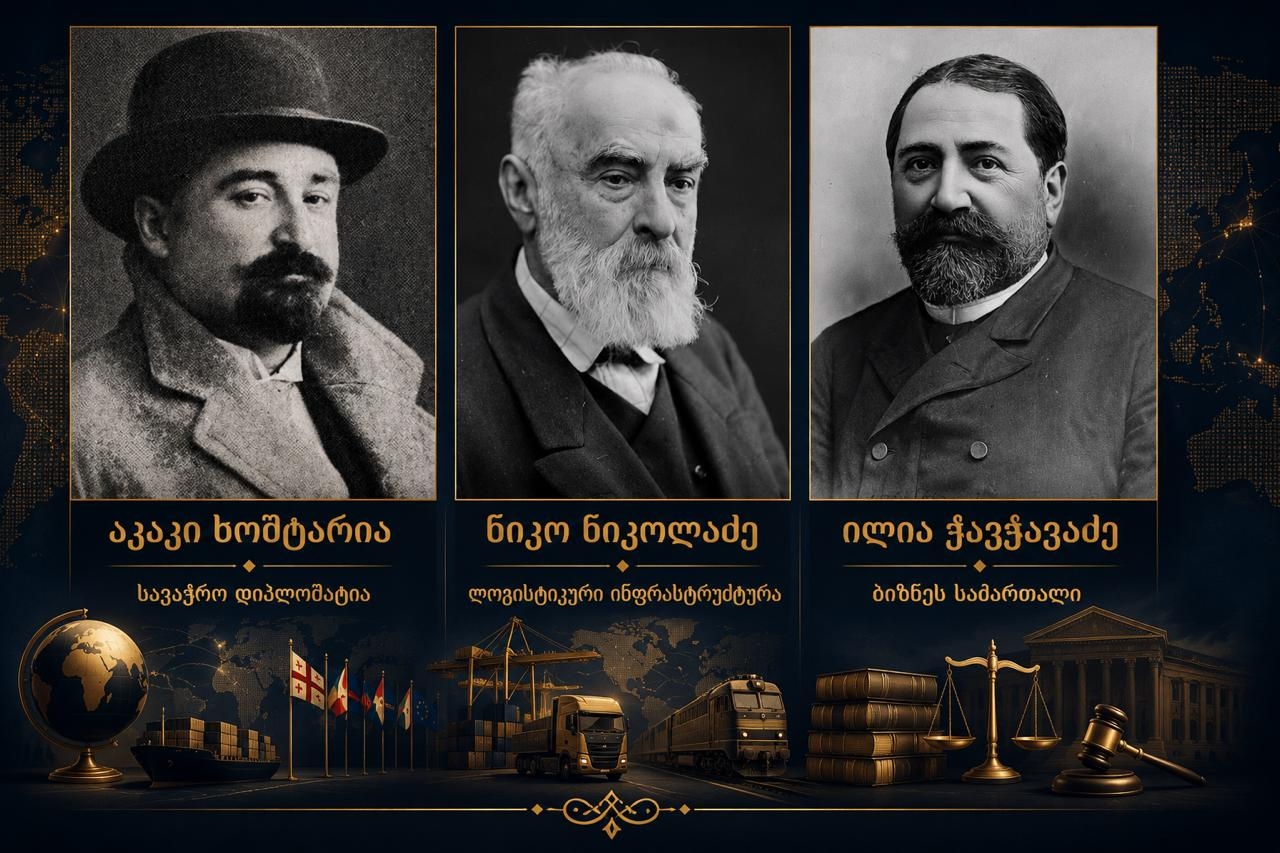
Speaking of infrastructure, it is worth mentioning that Niko
Nikoladze, the builder of the Georgian sea gate in Poti, voiced the idea in
1871 - to restore the oldest and shortest trade route from Europe to Asia
passing through Georgia, along the updated route: Berlin - Poti - Beijing.
Georgian trade diplomacy and logistics infrastructure
brought together
Akaki Khoshtaria, a Georgian financier, industrialist and
philanthropist, acquired oil concessions in Persia before the First World War
and established a large industrial company in Baku, "Rupento", which
conducted trade operations in the South Caucasus and Iran. He also founded the
"Khoshtaria Bank" in Baku, which conducted financial combinations
with leading countries of the world. Through his entrepreneurial and trade
activities, he gained great influence at the court of the Shah of Iran.
Khoshtaria was called the "Uncrowned Shah of Iran." The Ford car he
brought to Tehran as a gift to Ahmad Shah had golden wings as a decoration. He
did business in Turkey, Azerbaijan, and Iran. He founded a transportation
company in Tehran. He owned his own workshops, electric-powered factories, and
a special railway line, which was the first railway line in Iran.
Khoshtaria's extraordinary event is an unparalleled
combination of trade diplomacy and logistics infrastructure.
The Arab Stock Exchange and a Parallel with Georgia
If the London Stock Exchange is distinguished by British
business law, and the Amsterdam Stock Exchange by its trading history, one of
the unique features of the Dubai Stock Exchange is the combination of modern
global finance and Islamic finance based on Sharia. Which takes into account
the sectors restricted by Islamic law.
On the 10th century silver coin of the first king of united
Georgia, Bagrat III, the glorifications of Christ and Allah are depicted
together in Arabic. There is no similar case of harmonization of Islam and
Christianity in any culture. This is also a historical example from Georgia,
the merging of Islamic and global capitals on the Dubai Stock Exchange.
Georgian Business Law
Ilia Chavchavadze, as a true leader of the Georgian nation,
is himself a special phenomenon of Georgian business law. Before his many years
of leadership of the Tbilisi Noble Bank, he was a conciliatory judge. Ilia's
pen also embodied the idea of private
property and the liberalization of trade. In modern Georgia, the professional
days of a banker and a lawyer are celebrated together, on the same date -
November 8. Because for Ilia, business and law have never been inseparable.
P.S.
Georgian writer Grigol Robakidze: "Western Europe is
precious, but we cannot give up the East for Europe, it would be better to pay
for their wedding with a Georgian feast."
Robakidze's "precious Western Europe" is precisely
the Netherlands and the United Kingdom, with the corresponding trade diplomacy
and business law. The "unconquerable Middle East" is indeed the
United Arab Emirates, with a high index of logistical efficiency.
The "Georgian wedding feast" of Dutch trade diplomacy, Emirati logistics infrastructure and British business law requires a high-class, modern, independent and free "Tbilisi Stock Exchange".
Zurab Maghradze, Ph.D.